(pressing HOME will start a new search)


- ASC Proceedings of the 28th Annual Conference
- Auburn University - Auburn, Alabama
- April 9 - 11, 1992 pp 43 - 58
|
(pressing HOME will start a new search)
|
|
A COMPARATIVE ANALYSIS OF CONSTRUCTION COURSES AT SELECTED UNDERGRADUATE BUILDING CONSTRUCTION PROGRAMS IN THE UNITED STATES
|
The ultimate goal of construction education is to prepare an individual to improve the quality of the construction industry, initially through service as a viable employee. Therefore, construction curricula should be designed to reflect current real needs of the construction industry. Since the construction industry is undergoing an accelerated rate of change compared to twenty years ago, the knowledge and capabilities of its employees should not be static. A recent study by the Construction Industry Institute gathered data from 266 respondents of upper and middle managers of construction firms and facilitates owners as to what skills/ traits are required for an individual to perform well in various positions in today's construction industry.' The findings included:
|
Eleven construction positions were evaluated in this survey. Of these eleven, only five positions are suitable for new graduates of undergraduate building construction programs. These five are field engineer, site superintendent, estimator, project engineer, and project manager. The positions considered not suitable include senior executive, midlevel executive, trade superintendent, foreman, journeyman, sub‑journeyman. The survey provided rankings on ten skill/traits for these positions. The following are the results of the survey.
|
|
|
|
|
These results indicate what middle and upper managers feel is important in college level construction education. They may be summarized as follows:
|
The study concludes that application subjects such as scheduling, estimating and planning are important. Courses should incorporate elements to enhance development of strong problem solving and communication skills while general college courses are valuable in providing a well rounded individual for employment. The education process should create a base for the continuation of learning throughout the individual's life.
Another report supporting the view that construction education must be tailored to the needs of the industry is "Construction Curricula Needs Assessment Study" by Loughney and Reams.' This report is based on a study conducted by the faculty at Eastern Michigan University and is directed towards the needs of contractors within the state of Michigan. A survey ofgeneral contractors revealed the following five most important subjects (from a list of 43 subjects) for eight entry‑level positions in the construction industry:
|
The results demonstrated that contractors feel construction management is the most important area in the construction curriculum. A special study was undertaken at the M.E. Rinker, Sr. School of Building Construction, University of Floridato compare the state of current offerings in construction programs with the findings in these two studies. Various construction education programs across the country were evaluated to determine the type, sequencing, and amount of credit hours of construction courses offered by each particular program. A generic form was created to display each program's construction courses and their suggested sequence by semester/quarter. The course flow chart on the form uses three lines to describe a course. The first line lists the official course number followed by its credit hour value in parentheses. A brief course title is given in the second line. The last line is used for referencing subheadings of four key categories which are presented in the following paragraph.
The analysis was performed on each program's suggested course sequence. Courses were divided into four key categories:
1) Management, 2) Science, 3) Process, and 4) Electives.
The four key categories were further divided into subheadings which consisted of courses/subjects offered in construction programs. The categories and their respective subheadings are listed below.
|
|
|
|
Since the purpose of the study was to evaluate programs by construction‑related courses, courses taught outside a program's department (such as accounting, business law, and engineering economy) were not included. Due to this restriction, programs teaching these types of courses within their departments gain a distinct advantage in the results of the analysis over programs having these courses taught by other departments within the university. Courses such as these were included since use in construction is the main focus.
A few courses not taught within a construction department were included in the analysis since they relate directly to construction. A few examples of these courses are personal computers, structures and surveying. Due to the capacity of some programs, these types of courses are taught by other departments. Basic structure courses such as statistics are excluded while courses teaching the design of construction elements (steel, timber, and concrete) are included. By limiting the type of structure courses included in the analysis, the focus of the study is centered upon courses relating directly to construction.
There are many institutions throughout the country which offer building construction degrees. To analyze all of these institutions would require a great deal of time and effort. Therefore, this study is limited to selected building construction programs including all members of the ASC (Associated Schools of Construction) and any institution that incorporates a separate department for building construction. These programs were invited to participate and contacted by letter in the spring of 1990. The following information was requested:
|
a) A diagram of courses versus semester/quarter showing the sequence of courses. b) Extracts from the university/college catalog describing the construction program and the courses. c) Copies of course outlines describing the courses in greater detail. |
In return for their assistance, the contacted programs were offered similar information about the University of Florida's building construction program. Additionally, they were offered the results of the evaluation of University of Florida’s present courses and any changes resulting from this comparative study. In the Fall of 1990, programs not responding to the first letter were sent a second letter requesting the same information. The analysis is comprised of the programs that responded by submitting the requested information.
|
Institutions with multiple construction programs (or options) have each program listed with the exception of Purdue University (Civil Engineering College). Purdue University's Civil Engineering College has four construction options. The two options most closely resembling the majority of the other participants were chosen.
Another form sheet was created to analyze the number of each program's construction credit semester hours (SH). The form utilizes the key categories and subheadings described in the previous paragraphs combined with three columns to analyze the construction credit SH. The first column uses the course flow sheet to list the semester or quarter credit SH offered for each subheading. The second column provides the percentage of construction credit SH for each subheading. This is calculated by dividing the subheading SH by the total construction credit SH. The total number of construction credit SH is listed at the bottom of the form. The final column contains the subheading's percentage of construction credit SH compared to the overall total credit SH required for graduation. This percentage is found by dividing the subheading SH by the program's overall total SH. The overall total SH is listed in the upper right hand corner of the form. Key category subtotals are provided for each column in the lower portion of the form. The final totals are located at the bottom of the form under each column.
Although some programs may show no courses under a subheading, the material from this subheading may be covered in courses listed under other subheadings. Construction courses often combine numerous topics into one course. For example, a course teaching CADD (Computer Aided Drafting and Design) is considered both a computer and drawing course. The analysis attempts to incorporate these courses by dividing the credit SH into their respective areas. Therefore, half of a CADD course would be listed under the subheading computers and half under the subheading drawing.
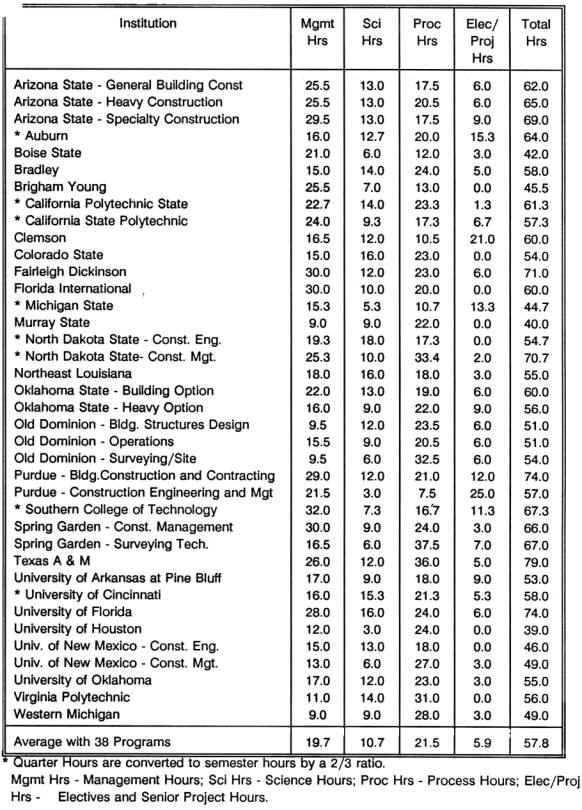
The breakdown of semester hours (SH) in construction courses, Table 1, provides an overall view of the construction programs incorporated in this study. This table supplies the number of SH for the four key categories of management, science, process, and electives for each program. The analysis is performed in semester credit SH. Programs utilizing a quarter system are converted to semester credit SH by multiplying the quarter credit SH by a 2/3 factor. The bottom of the table provides the average SH for each category.
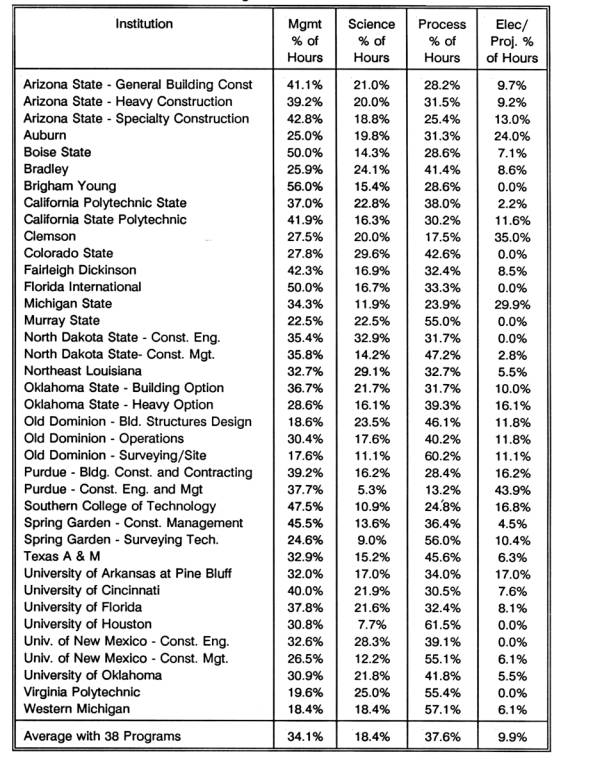
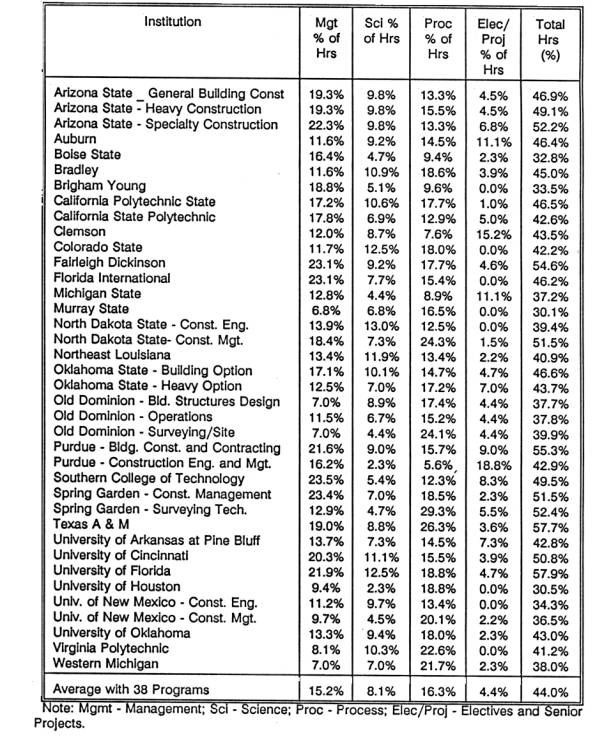
Percentage breakdown of construction SH, Table 2, provides an overall view of the percentage breakdown for all programs. This table lists all the programs' percentage of construction SH devoted to each key category for comparison analysis. The bottom of the table provides the average percentage for each category.
The paragraphs following the tables discuss the results of a ranking performed on the programs. The programs are ranked according to the required number of construction SH. The rankings do not reflect the type of courses provided nor the quality of the programs.
The following numbers are the average number of construction SHand standard deviations for the key categories found in Table 1. The average percentage of each key category is provided from the bottom of Table 2.
|
Table 2 |
|||
|
|
SH |
Stnd.
Dev. |
Percentage |
|
Management |
19.7 |
6.84 |
34.1% |
|
Science |
10.7 |
3.72 |
18.4% |
|
Process |
21.5 |
6.71 |
37.6% |
|
Electives |
5.9 |
5.70 |
9.9% |
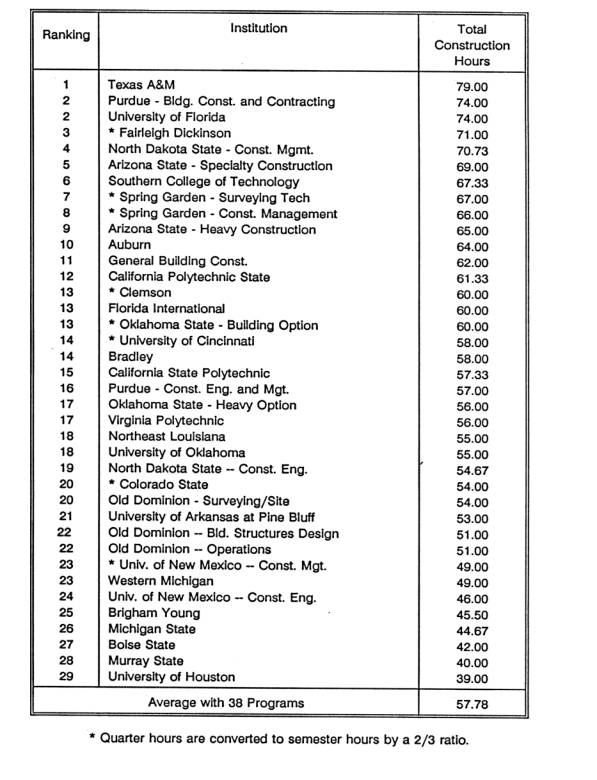
Total construction SH for the programs range from 39 to 79 SH, with a statistical mean of 57.8 SH and a standard deviation of 9.77 SH. Table 3 provides a ranking of total construction SH. Texas A & M's program has the highest number of total construction SH with 79 SH devoted to construction courses.
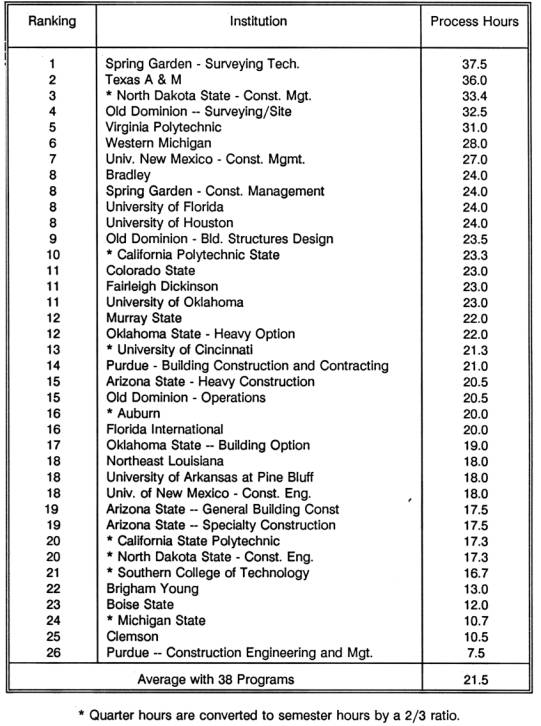
The results of this study shown in Table 4 demonstrate that undergraduate building construction programs, on the average, devote the majority of their curriculum to the construction process category. This category contains the highest average of SH,21.5,ofthefourkeycategories. The 21.5 process SH equals 37.6 percent of all construction SH. Ranking of process category, Table 4, lists the programs in decreasing order of process SH.
Of the 3 8 programs, 21 programs (including one tie with the management category) devote the majority of their construction SH to the process category. It should be stated that two of these programs are surveying programs. Old Dominion University and Spring Garden College devote 15 and 21 SH respectively towards surveying courses which raises their total process category SH considerably. The surveying courses account for 20.3 percent of the construction courses of Old Dominion's program and 28.4 percent of Spring Garden's program.
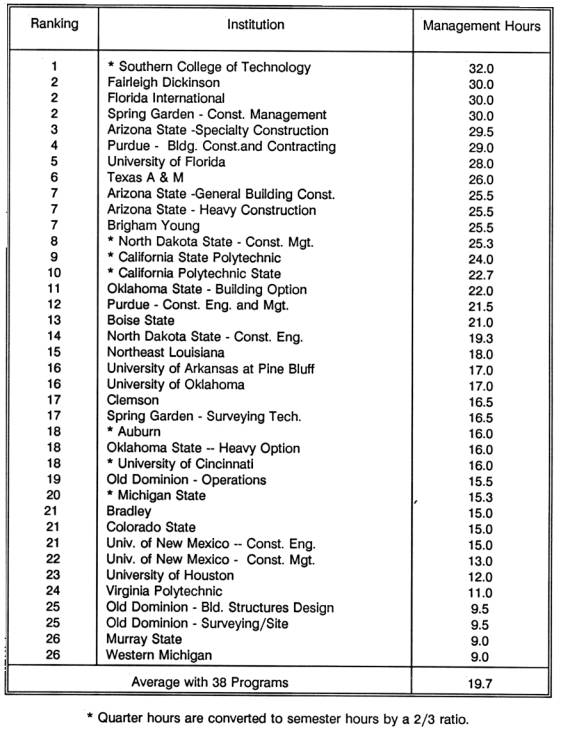
The management category contains the second highest average number of construction SH. Programs average 19.7 SH of management courses or 34.1 percent of the total construction courses. Ranking of management category, Table 5, lists the programs in decreasing order of management SH.
Sixteen programs (which includes one tie with the process category) out of the 3 8 programs show the greatest emphasis on the management category. The sixteen programs devote the largest portion of their construction SH to this category.
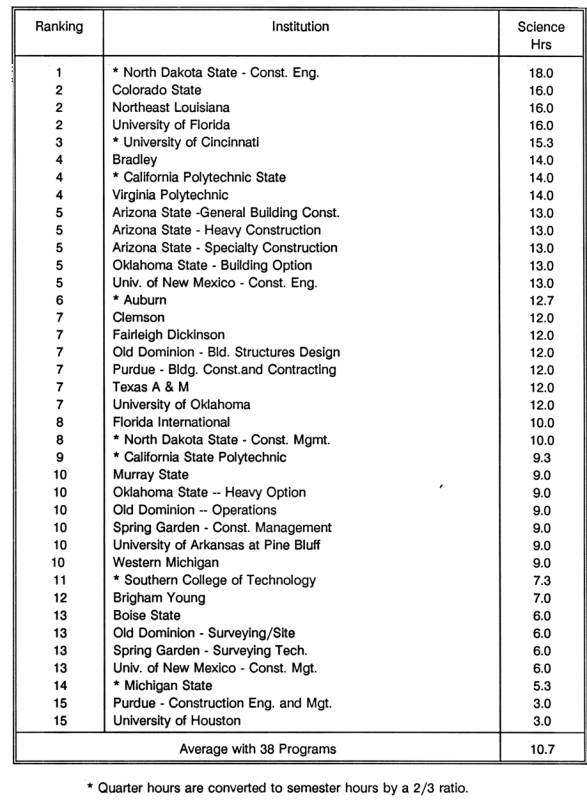
While three of the four key categories show a wide range of SH between institutions, the number of science SH displays a great degree of similarity. Programs average 10.7 science SH with a standard deviation of 3.72 SH. This amounts to 18.4 percent of the total construction SH. Table 6 ranks the programs by descending order in the number of science category SH for each program.
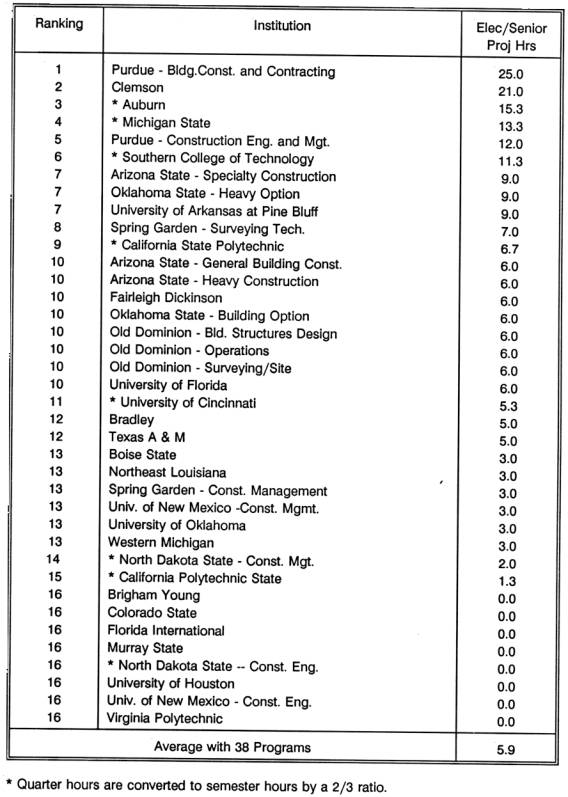
The electives subheading refers to electives credit SH of construction courses. These electives provide students with the opportunity to choose from a variety of construction courses. These elective credit SH exclude courses not relating directly to construction. Senior seminar courses are also included under the electives subheading. The senior project subheading includes courses pertaining to senior projects, special research and summer employment.
The electives category has the lowest average number of construction SH of the four categories. Ranking of electives category, Table 7, lists the programs in decreasing order of elective SH. Programs devote 5.9 SH, on the average, to the electives category which accounts for 9.9 percent of all construction courses.
Eight programs have zero SH listed in this category. Closer analysis reveals three other programs offer senior project SH but no SH in elective construction courses. Therefore, a total of eleven programs do not offer students electives in construction courses.
In contrast, Clemson University and Purdue University (Construction Engineering and Management) offer the greatest number of SH in the electives category. Purdue's program has the highest number, 25 SH, in the electives category. This equals 43.9 percent of their construction courses. Of the 25 SH, the program offers 19 SH of electives (5 or 6 courses depending on option). Since Purdue's program has four options, students select construction electives listed for their option.
Clemson's program has 21 SH in the electives category. Clemson offers students the opportunity to choose 15 SH of pre‑approved elective construction courses (five courses). Therefore 35 percent of the construction courses are offered as electives. The remaining six SH of the electives category are under the senior project subheading.
Total SH required to graduate varies among programs. SH required to graduate range from 120 to 138 SH. There are four programs requiring 138 SH: Auburn University, Clemson University, North Dakota State University (Construction Engineering), and the University of Cincinnati. Of these four programs, only the University of Cincinnati incorporates a five year program to accommodate the large total credit load.
The percentage of construction SH compared to the total required SH, Table 8, ranges from 30.1 to 57.9 percent. The statistical mean is 44.0 percent, with a standard deviation of 7.34 percent.
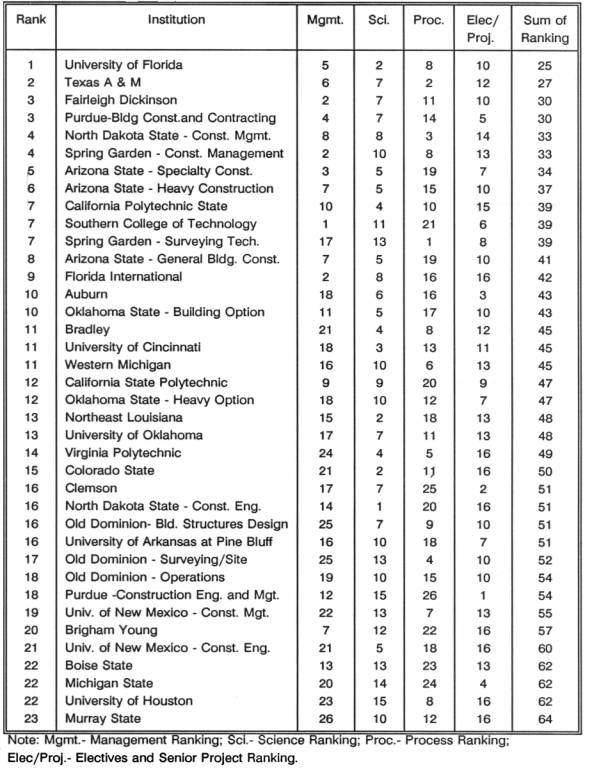
The sum ranking of program standings in key categories may be found in Table 9 which provides an overall view of Tables 4,5,6, and 7. The number rankings in the categories refer to program standings. The lowest number indicates the highest number of SH in each category. The final column lists the summation of the four key category standings. The programs are ranked according to the required number of construction SH per key category. The rankings do not reflect the quality of courses nor of the programs.
The building construction curricula should be under constant review due to changes in the industry and research.
Regular Reviews ‑ The chairman of a building construction department should schedule regular meetings with professors for the sole purpose of reviewing emerging trends and new developments. They can then be incorporated into current or future courses.
Lengthen Programs ‑ Currently, most construction programs are squeezed into four years. "To introduce new areas of study into the curriculum or to treat already‑covered areas in greater depth in any of the four‑year programs is not feasible," according to C.H. Oglesby, Professor at Stanford University [Oglesby, 1990]. New developments in construction education need to be incorporated into current classes. The need
to accommodate new information and maintain current course loads suggest a fifth year be added to programs. An additional year would also provide room for more electives for students to customize their construction education.
Industry’s Preference‑ The construction industry is stressing the need for construction management skills in entry‑level management positions. Therefore construction programs should place the greatest emphasis on construction management courses incorporating problem‑solving skills.
The following is a list of related areas to be investigated for the purpose of providing insight for improvements to undergraduate building construction programs.
|
Organizing construction courses into generic course flow charts graphically shows the quantity and sequence of required construction courses. According to these charts, construction programs currently emphasize the construction process. This provides students with a strong base in such subjects as techniques, surveying, materials and drawings. However, the industry feels communication and problem‑solving are the most important criteria. Construction management courses incorporate these skills and therefore should carry the greatest emphasis.
Dorsey, R.W., (1991). Industry views on What is Valuable in Construction Education and Training, The American Professional Constructor, Journal of the American Institute of Constructors, Vol. 15, No. 1, January 1991.
Loughney, P.J., & Reams, J.S. (1990). Construction Curricula Needs Assessment Study, Journal of Industrial Technology.
Oglesby, C.H. (1990). Dilemmas Facing Construction Education and Research in 1990's. Journal of Construction Engineering and Management, Vol. 116, No. 1, March, 1990.
|
|
|
|
|
|
|
|
|
|
|
|
|
|
|
|
|
|
|
|
|
|
|
|
|
|
|